A good patio heater is the difference between heading indoors at eight o’clock and staying out under a blanket until the candles burn down. In a British winter, when the evenings are long and the air has a proper bite, a bit of extra warmth makes your rattan sofa feel like somewhere you actually want to sit, not just something you look at through the window.
The tricky part is choosing. Gas, electric and infrared heaters all promise cosy evenings, but they heat in different ways, cost different amounts to run and suit different spaces. Here’s a plain guide to what each type does well, where it falls short, and how to pick the right one for your garden.
How patio heaters actually work
There are two ways to heat outdoors. Some heaters warm the air around them, which works fine on a still night but drifts away the moment there’s a breeze. Others give off radiant heat, which warms people and furniture directly, a bit like standing in sunshine. Most outdoor heating relies on radiant heat for exactly that reason: you can’t heat the sky, so you heat the people sitting under it.
That’s why you’ll see “heat output” quoted in kilowatts (kW). A tall gas patio heater might be rated at around 13kW, while an electric infrared model is usually 1.5kW to 2.5kW. Those numbers aren’t directly comparable, though. Gas heaters lose a lot of warmth to the air, while infrared heat goes straight to whatever it’s pointed at, so a 2kW electric heater can feel surprisingly warm if you’re sitting in its beam.
Gas patio heater: big heat, no plug needed
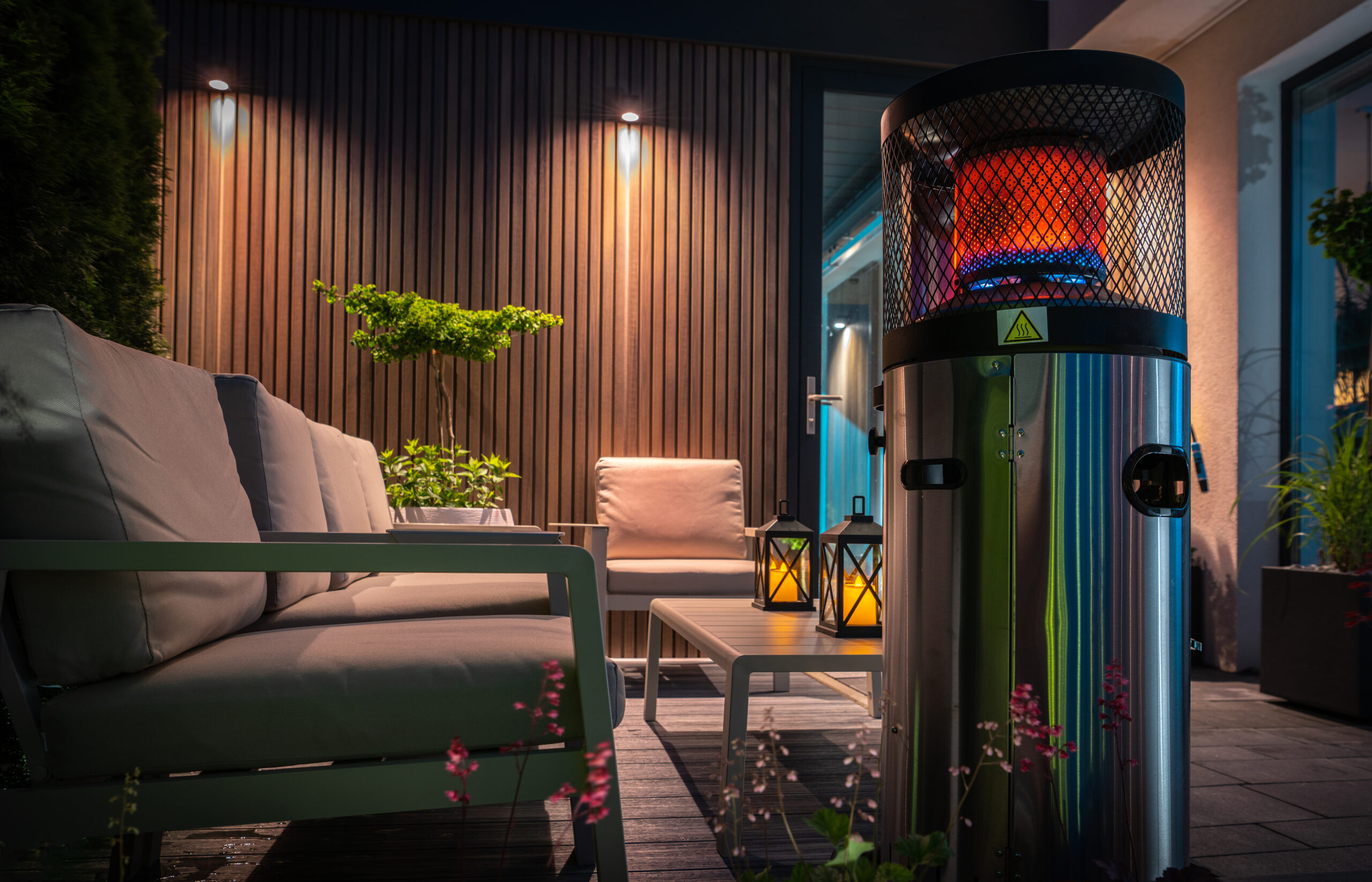
The classic gas patio heater is the tall stainless steel or black mushroom-topped stand you see outside pubs, plus the pyramid styles with a glass flame tube. They run on propane from a bottle hidden in the base.
- Pros: lots of heat across a wide circle, no cables, and you can put one anywhere on the patio. A real flame looks lovely after dark, especially the pyramid designs.
- Cons: you’ll need to buy and swap gas bottles, they’re bulky to store, and on a windy evening much of the warmth blows away. They also tend to be the priciest option to run per hour.
Gas is best for larger patios, parties and gardens with no outdoor socket. Always use propane rather than butane for winter use, as butane struggles in the cold.
Electric patio heater: simple and tidy
An electric patio heater plugs into an outdoor socket and usually uses a halogen or carbon element. You’ll find free-standing patio models on a stand, wall-mounted bars and small portable table-top heaters.
- Pros: instant heat at the flick of a switch, no bottles, quieter and lighter to move. Many have several heat settings and a remote control, so you can turn them down once everyone’s warmed up.
- Cons: you’re tied to a power supply, and they heat a smaller area than gas. Cheaper bulbs can give off a bright orange glare that’s not ideal for a relaxed evening.
Use a weatherproof outdoor socket with RCD protection, and get an electrician to fit one if you don’t already have it. Avoid running extension leads across a damp lawn.
Infrared patio heater: the efficient choice
Strictly speaking, most electric heaters are infrared, but the term usually refers to newer carbon or “low glare” designs. An infrared patio heater converts nearly all its energy into radiant heat, so very little is wasted warming the air.
- Pros: efficient, quick to warm up and less affected by wind. Low-glare and ultra low glare models give a soft light rather than a harsh red glow, which suits a terrace or covered seating area.
- Cons: the warmth is directional, so people outside the beam won’t feel much. Good low-glare models cost more up front.
If you’re asking what the best heater for outdoor patio use is on a typical British evening, infrared is usually the answer for small to medium spaces, and gas for big open patios.
Gas vs electric vs infrared at a glance
| Type | Best for | Heat area | Watch out for |
|---|---|---|---|
| Gas (propane) | Large patios and parties | Wide circle around the stand | Bottle swaps, wind, bulk |
| Electric halogen | Occasional use near the house | Small to medium | Glare, needs a socket |
| Infrared carbon | Regular use, covered areas | Directional beam | Higher upfront cost |
| Table-top (gas or electric) | Bistro sets and balconies | One small table | Stability, limited reach |


Choosing the right patio heater for your space
How many heaters do you need?
As a rough guide, one tall gas heater warms a group sitting round a table or a compact corner sofa. A 2kW infrared heater suits two to four people within a couple of metres. For a large L-shaped set, two smaller heaters at different corners often work better than one big one, because everyone gets some warmth.
Free-standing, wall-mounted or table-top?
Free-standing heaters on a stand are flexible and easy to move. Wall-mounted heaters save floor space and sit out of the way of children and pets. Table-top heaters are handy for small spaces but can be knocked over, so they suit a sturdy table rather than a wobbly bistro set.
Features worth paying for
- A tilt stand or adjustable head, so you can aim the heat where people sit.
- Several heat settings and a remote control.
- A good IP rating (IP55 or above) if the heater will stay outdoors.
- An anti-tilt cut-off switch on gas and free-standing models.
Prices start from around £80 for basic electric heaters and from around £150 for a decent gas or infrared model. Compare the range in our patio heaters collection.
Safety and positioning
A few UK safety basics apply to every type. Patio heaters are for outdoor use only, so never use a gas heater indoors, in a garage or in an enclosed space, because of the risk of carbon monoxide. Keep the top of any heater well clear of parasols, low ceilings, overhanging branches and fabric. A heater inside a closed gazebo is a bad idea unless the manufacturer specifically says the model is suitable and the sides are open. If you want covered seating, check the clearance guidance before choosing a garden gazebo.
Stand heaters on a flat, firm surface, keep cushions and throws a sensible distance away, and turn them off when you go inside. Check gas hoses and regulators each season for cracks, and replace them if in doubt.
Patio heater or fire pit?
A fire pit gives a sociable glow and a focal point, while a heater gives more even warmth without the smoke. Many people end up with both: a heater for the dining area and a fire pit table for the lounge. Our guide to rattan fire pit table sets explains how they combine with corner sofas. Whichever you choose, put a fitted furniture cover back on afterwards so damp doesn’t soak into the cushions overnight.
Patio heater FAQs
Are patio heaters waterproof?
Most are weather-resistant rather than fully waterproof. Check the IP rating, and cover or store the heater when it’s not in use, especially through the wettest months.
Are electric patio heaters expensive to run?
Running cost depends on wattage and your tariff. A 2kW heater uses 2kWh per hour on full power, so lower heat settings and switching off when you head in make a real difference.
Can you put a patio heater in a gazebo?
Only if the manufacturer says the model is suitable, the sides are open and there’s plenty of clearance above the heater. Never use a gas heater in a closed gazebo.
Where is the best place to position a patio heater?
Close to where people sit, sheltered from the prevailing wind and well away from anything that could catch fire. Aim infrared heaters at seats rather than at open space.